The World Crisis, Vol. 4 (Winston Churchill's World Crisis Collection) by Winston S. Churchill
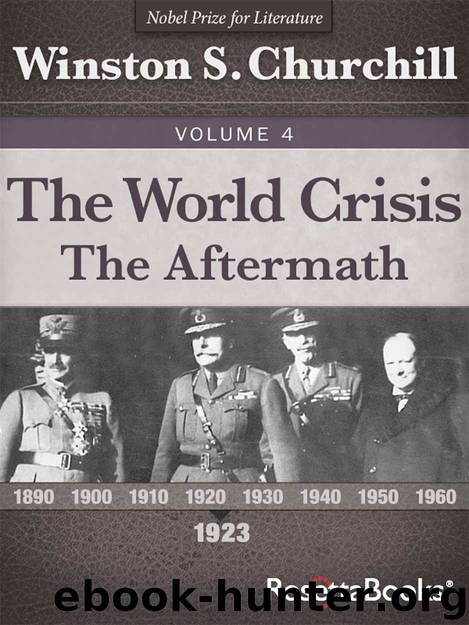
Author:Winston S. Churchill [Churchill, Winston S.]
Language: eng
Format: epub, mobi
ISBN: 9780795331510
Publisher: RosettaBooks
Published: 2013-09-23T06:00:00+00:00
I can see now the pale faces and staring eyes of the deputation of townsfolk from Archangel who visited me at the War Office at the end of July, 1919, to beg for further British protection, to whom I had to return ‘a dusty answer.’ All these poor workpeople and shopkeepers were soon to face the firing parties. The responsibility for their fate rests upon the mighty and resplendent nations who had won the war, but left their task unfinished.
No sooner had the correspondence between Kolchak and the Big Five terminated satisfactorily on June 12, 1919, than his collapse began. In the early part of June General Gaida’s Northern Army made some slight progress round about Glazov. But this did not disguise from our representative, General Knox, that the situation of Kolchak’s forces was very unfavourable. The Siberian Western Army had been heavily defeated at the beginning of May in front of Ufa, and at the end of June the Northern Army was involved in its rout. By the end of the month therefore the Western and Northern Armies had fallen back over a hundred and fifty miles to Perm. At the beginning of July the line here ran approximately as follows: East of Perm—Kungar—Krasnoufimsk—Simsk—Sterlitimak—Orenburg. During July the retreat of the Siberian armies continued without interruption; by the end of the month they had evacuated Ekaterinburg and Chelyabinsk, and had lost the line of the Urals. At the beginning of August the Supreme Council decided to give no further help to Kolchak who was evidently fast losing his grip of the situation. General Knox said of the Siberian armies: ‘The men are listless and slack, and there is no sign of their officers taking them in hand. The men do not want rest, but hard work and discipline…. The enemy boasts he is going to Omsk, and at the moment I see nothing to stop him. As it retires the army melts, the men desert to their villages or to convey their families to safety.’ The retirement of the Siberian army continued throughout August. At the beginning of September they still had a numerical superiority over the Bolsheviks, but having retired since May their morale was very bad. Nevertheless at the beginning of September General Dietrichs struck back at the enemy and recovered nearly a hundred miles. The success was short-lived, and Petropavlovsk was occupied by the Bolsheviks on October 30. The Southern Army continued to retreat, broke up and ceased to be a factor in the military situation. There was nothing therefore between the Bolsheviks and Omsk, which was evacuated on November 14. The Government moved to Irkutsk on November 17. General Gaida attempted a coup d’état at Vladivostok, which appeared for the moment to galvanise the Irkutsk Government into life. Such public opinion as existed in Siberia was however becoming increasingly estranged from Kolchak; and Bolshevik propaganda grew daily more seductive.
While all this was in progress I had done my best in pursuance of the decisions of the Supreme Council to guide and encourage Kolchak.
Download
The World Crisis, Vol. 4 (Winston Churchill's World Crisis Collection) by Winston S. Churchill.mobi
This site does not store any files on its server. We only index and link to content provided by other sites. Please contact the content providers to delete copyright contents if any and email us, we'll remove relevant links or contents immediately.
| Africa | Americas |
| Arctic & Antarctica | Asia |
| Australia & Oceania | Europe |
| Middle East | Russia |
| United States | World |
| Ancient Civilizations | Military |
| Historical Study & Educational Resources |
The Radium Girls by Kate Moore(12028)
100 Deadly Skills by Clint Emerson(4924)
Rise and Kill First by Ronen Bergman(4788)
The Templars by Dan Jones(4689)
The Doomsday Machine by Daniel Ellsberg(4490)
The Rape of Nanking by Iris Chang(4211)
Killing England by Bill O'Reilly(4001)
Stalin by Stephen Kotkin(3965)
Hitler in Los Angeles by Steven J. Ross(3946)
12 Strong by Doug Stanton(3548)
Hitler's Monsters by Eric Kurlander(3341)
Blood and Sand by Alex Von Tunzelmann(3203)
The Code Book by Simon Singh(3189)
Darkest Hour by Anthony McCarten(3129)
The Art of War Visualized by Jessica Hagy(3007)
Hitler's Flying Saucers: A Guide to German Flying Discs of the Second World War by Stevens Henry(2754)
Babylon's Ark by Lawrence Anthony(2677)
The Second World Wars by Victor Davis Hanson(2524)
Tobruk by Peter Fitzsimons(2516)
